

Introduction
Collagen supplement ODM is suitable for brands that want to develop collagen powder sachets, collagen drinks, capsules, tablets, gummies, or beauty-focused nutritional products. Compared with simple OEM manufacturing, ODM services focus more on formula development, ingredient selection, flavor adjustment, dosage form planning, packaging strategy, and market positioning.
Before starting a collagen supplement project, brands should first clarify their target market, target consumers, dosage form, collagen source, functional ingredients, packaging format, regulatory requirements, and sales channels. Choosing an ODM manufacturer with collagen ingredient resources, sampling capability, mass production experience, quality control systems, and export document support can help brands move from concept to launch more efficiently.
Table of Contents
- 1. What Is Collagen Supplement ODM? Which Brands Is It Suitable For?
- 2. What Product Forms Can Collagen Supplements Be Made Into?
- 3. How Should a Collagen Supplement ODM Formula Be Designed?
- 4. What Is the Development Process for Collagen Supplement ODM?
- 5. What Factors Affect Collagen Supplement ODM Cost?
- 6. What Should Brands Know About Collagen Supplement Labeling and Marketing?
- 7. How to Choose a Collagen Supplement ODM Manufacturer?
- Conclusion
- FAQ
1. What Is Collagen Supplement ODM? Which Brands Is It Suitable For?
What is the difference between collagen supplement ODM and OEM?
Collagen supplement OEM usually means the brand already has a confirmed formula, product specification, or production requirement, and the manufacturer produces the product accordingly. ODM, on the other hand, involves more product development support, including formula design, ingredient recommendations, dosage form selection, flavor testing, and packaging planning.
If a brand already has a mature formula, OEM may be enough. If the brand only has a product idea, such as “a beauty collagen powder for women” or “a premium collagen drink for mature consumers,” ODM is usually more suitable.
Why is ODM suitable for developing collagen supplements?
Collagen products involve many development details, including collagen source, molecular weight, flavor profile, ingredient compatibility, dosage form, packaging, and compliant marketing language. For brands without an in-house R&D team, it can be difficult to judge which formula is realistic for production and suitable for the market.
An ODM manufacturer can provide existing formulation experience, raw material options, sample development, and production feasibility advice, helping the brand reduce trial-and-error time.
Can beauty brands, nutrition brands, and e-commerce brands use ODM services?
Yes. Collagen supplements are commonly developed by beauty brands, nutritional supplement brands, e-commerce brands, clinics, wellness channels, and cross-border brands. If a brand already serves female consumers, mature consumers, beauty-focused customers, or wellness audiences, collagen supplements can be a strong extension of the product line.
However, brands should clearly define whether the product is positioned as a daily beauty supplement, a premium anti-aging-oriented supplement, a convenient functional drink, or a broader wellness product.
How can ODM services shorten product development time?
ODM manufacturers usually already have collagen raw material resources, formula experience, dosage form suggestions, sampling processes, packaging suppliers, and production systems. This allows brands to move from product concept to sample testing more quickly.
If the ODM manufacturer can also support export documents, product specifications, quality reports, and labeling suggestions, it becomes especially helpful for brands planning to sell in international markets.
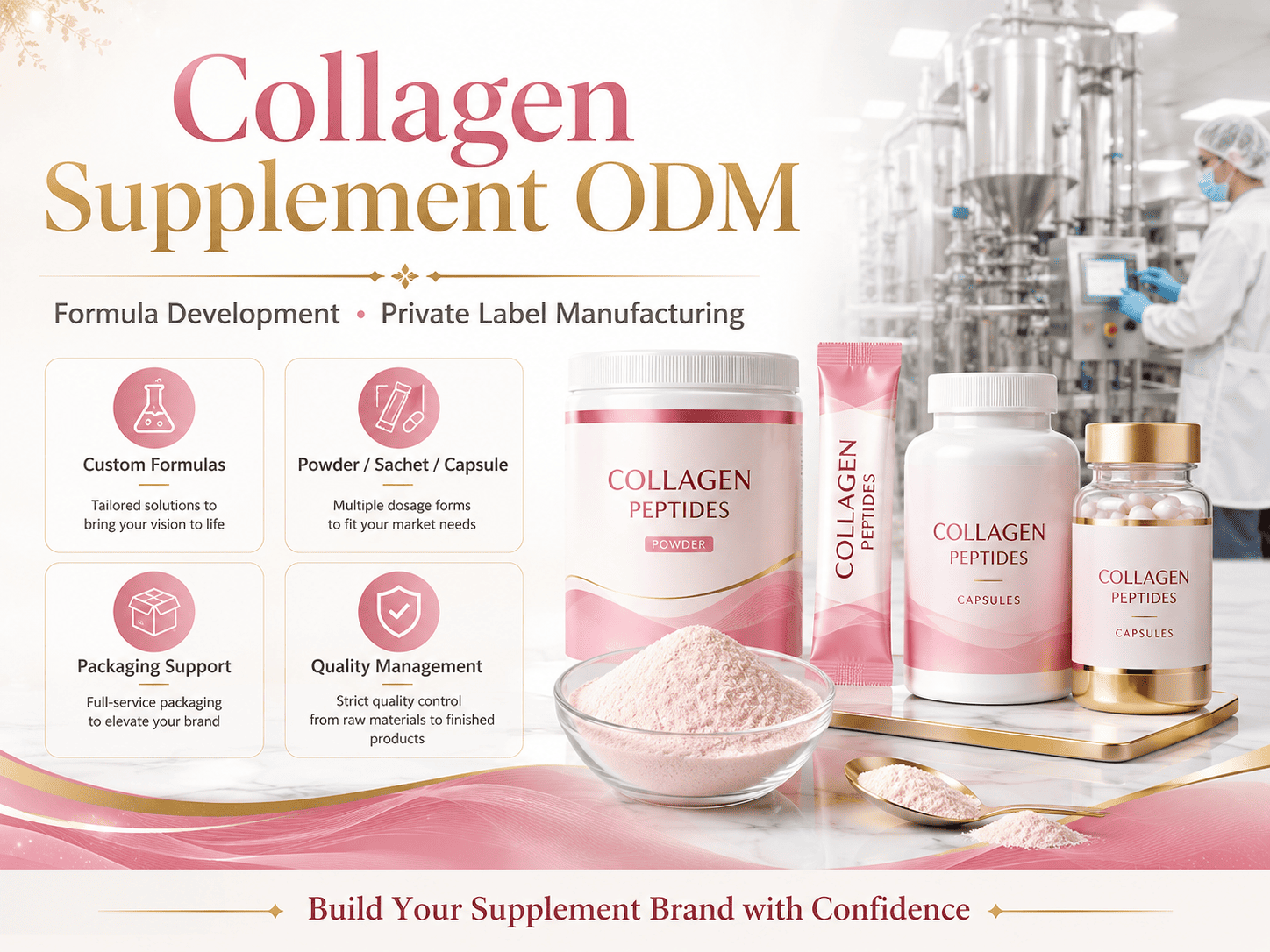
2. What Product Forms Can Collagen Supplements Be Made Into?
Are collagen powder sachets the most common format?
Collagen powder sachets are one of the most common product forms because collagen usually requires a relatively higher daily serving amount. Powder sachets can carry more collagen per serving and are easy to combine with vitamin C, hyaluronic acid, ceramides, elastin, or fruit flavor powders.
Single-serving sachets are also convenient for e-commerce, travel, sampling packs, and premium gift box designs.
How do collagen drinks, tablets, capsules, and jelly sticks compare?
Collagen drinks are convenient and ready to consume, making them suitable for consumers who value ease of use and taste. Tablets and capsules are portable and easy to store, but the collagen amount per serving may be limited due to capsule or tablet size. Jelly sticks offer a snack-like texture and are often used for younger consumers or lifestyle-oriented beauty products.
Each dosage form affects cost, minimum order quantity, shelf life, packaging design, and consumer experience.
What is the difference between fish collagen, bovine collagen, and collagen peptides?
Fish collagen is commonly used in beauty supplement products and is often associated with skin care and premium beauty positioning. Bovine collagen is also widely used in nutritional products, depending on the product concept and market acceptance. Collagen peptides refer to hydrolyzed collagen, which is commonly used in powders, drinks, and supplement formulas.
When selecting collagen ingredients, brands should check the source, specification, solubility, taste, allergen concerns, documentation, and target market requirements.
Do different dosage forms affect taste, cost, and market positioning?
Yes. Powder and drink products require more attention to flavor, odor, solubility, sweetness, and mouthfeel. Capsules and tablets focus more on serving size, swallowing experience, and convenience. Jelly sticks focus on texture, stability, and packaging appeal.
A premium beauty brand may focus on branded ingredients and elegant packaging, while a mass-market product may prioritize taste, price, and daily convenience.
3. How Should a Collagen Supplement ODM Formula Be Designed?
Can collagen be combined with vitamin C?
Yes. Vitamin C is commonly used in collagen supplement formulas because consumers are familiar with it and it fits well with beauty and wellness positioning. Many collagen powders and drinks combine collagen peptides with vitamin C for daily nutritional support.
However, marketing language should remain compliant and avoid guaranteed or medical-effect claims.
Are hyaluronic acid, ceramides, and elastin common in collagen formulas?
Yes. Hyaluronic acid, ceramides, elastin, vitamin C, vitamin E, yeast extracts, berry extracts, and selected plant extracts are commonly used in collagen beauty supplement formulas. These ingredients can help create a more complete product positioning.
Still, formula design should not simply add as many ingredients as possible. Brands should consider dosage, cost, flavor, stability, and labeling compliance.
What is the difference between beauty-focused and sports nutrition collagen products?
Beauty-focused collagen supplements usually target women, mature consumers, and skin care-oriented customers. These products often emphasize taste, packaging, beauty ingredients, and daily lifestyle use.
Sports nutrition collagen products may focus more on protein support, mobility, active lifestyles, or post-workout nutrition positioning. The target audience, formula design, and marketing tone can be very different.
How should formulas be designed for women, mature consumers, or premium beauty users?
For female consumers, flavor, packaging, and convenient daily use are often important. For mature consumers, the formula may focus on a more complete nutritional profile and long-term daily maintenance. For premium beauty users, ingredient source, branded raw materials, product story, and packaging quality become more important.
Collagen supplement ODM project should always start with the target consumer before deciding on collagen source, dosage form, formula structure, and packaging.
4. What Is the Development Process for Collagen Supplement ODM?
What product requirements should the brand provide first?
The brand should provide its target market, sales channel, target audience, budget range, preferred dosage form, flavor direction, packaging format, expected order quantity, and competitor references. If the product is intended for export, the target country or region should also be confirmed early.
Clear requirements help the ODM manufacturer provide more accurate formula suggestions and cost estimates.
How are ingredient selection, flavor adjustment, and dosage design handled?
The ODM manufacturer will suggest collagen sources, serving size, functional ingredients, flavor systems, and dosage form options based on the brand’s positioning. For powders and drinks, multiple flavor trials may be needed to adjust sweetness, acidity, aroma, solubility, and aftertaste.
Dosage design should balance market expectations, serving size, product cost, packaging capacity, and consumer convenience.
What happens during sample testing and formula adjustment?
After the first sample is prepared, the brand can test the flavor, aroma, color, solubility, texture, and overall consumer experience. If the sample does not match the desired direction, the manufacturer can adjust sweetness, flavor intensity, ingredient ratio, or powder performance.
The sampling stage is important because it helps avoid market acceptance issues after mass production.
What specifications and documents should be confirmed before production?
Before mass production, the brand should confirm the formula, raw material specifications, packaging artwork, label content, testing items, production quantity, shelf life, delivery schedule, and logistics arrangements. For export products, English documents, ingredient specifications, and market-specific labeling requirements may also be needed.
Confirming these details before production can reduce the risk of costly revisions later.
5. What Factors Affect Collagen Supplement ODM Cost?
Does collagen source and raw material grade affect price?
Yes. Different collagen sources, grades, branded ingredients, specifications, and supporting documents can lead to significant cost differences. Fish collagen, bovine collagen, branded collagen peptides, and premium raw materials may all have different pricing structures.
Brands should choose collagen ingredients based on product positioning, not just the lowest cost.
Do packaging format, MOQ, and custom formulas affect cost?
Yes. Powder sachets, bottled drinks, capsules, tablets, jelly sticks, box packaging, and premium gift sets all have different cost structures and minimum order quantities. Custom formulas usually require more sampling, testing, and development work.
Lower MOQ may lead to a higher unit cost, while larger production volumes require careful inventory and shelf-life planning.
Are flavor development, testing, and design services charged separately?
They can be. Flavor development may require multiple rounds of sampling. Testing items may vary depending on the product and sales channel. Packaging design, label layout, and regulatory review may also be charged separately.
Brands should confirm whether the quotation includes sampling, testing, packaging, artwork support, and documentation.
Why should collagen products not be compared only by low unit price?
Collagen supplements depend heavily on raw material quality, flavor experience, packaging quality, documentation, and production stability. A low unit price may come with compromises in ingredient source, flavor, testing, or brand perception.
For long-term brand development, repeat purchase, consumer trust, and product consistency are often more important than the lowest manufacturing price.
6. What Should Brands Know About Collagen Supplement Labeling and Marketing?
Can collagen supplements claim beauty effects?
As nutritional supplements or food products, collagen supplements should avoid medical, guaranteed, or exaggerated beauty claims. Safer expressions include “daily beauty nutrition,” “beauty supplement support,” “daily wellness routine,” or “nutritional support for beauty-conscious consumers.”
Claims such as curing skin problems, reversing aging, whitening skin, removing wrinkles, or guaranteeing visible results may create regulatory risks.
What labeling and regulatory differences should export products consider?
Different markets may have different requirements for ingredient names, nutrition facts, allergen statements, warning labels, serving instructions, import documents, and advertising language. A package designed for one market may not be suitable for another market without review.
Brands planning to sell in Hong Kong, Taiwan, Singapore, Malaysia, the United States, Europe, or other regions should confirm local requirements early in the development stage.
How can SEO content avoid exaggerated or medical claims?
SEO content can explain collagen sources, dosage forms, ingredient combinations, product selection tips, and supplement development considerations. It should avoid presenting the product as a treatment or guaranteed solution.
Educational content, comparison articles, and product selection guides are safer and more useful for long-term SEO performance.
Can ODM manufacturers support labeling and compliance suggestions?
Some ODM manufacturers can support label review, ingredient documents, testing reports, product specifications, and export documents. However, the brand is still responsible for final product claims, advertising content, and compliance in the sales market.
When selecting an ODM manufacturer, brands should ask whether regulatory, quality assurance, and documentation support are available.
7. How to Choose a Collagen Supplement ODM Manufacturer?
What R&D capabilities should a collagen ODM manufacturer have?
A qualified collagen ODM manufacturer should understand collagen raw materials, formula design, powder processing, drink formulation, capsule and tablet production, jelly stick development, flavor adjustment, and sample testing.
A manufacturer with strong R&D capability can help the brand develop a more market-ready product instead of only providing basic production.
Why are ingredient resources, flavor adjustment, and production stability important?
Collagen products often face challenges such as odor, solubility, flavor balance, texture, and batch consistency. If the ODM manufacturer has stable ingredient resources and strong flavor development experience, the final product is more likely to be accepted by consumers.
Production stability is also important because each batch should maintain consistent quality, taste, and appearance.
Should export experience, English documents, and international certifications be checked?
Yes. For international brands or export projects, the manufacturer’s export experience, English documentation, product specifications, certificates, and testing support are very important. These documents may be needed for customs clearance, distributor review, or retail channel approval.
International certifications such as GMP, HACCP, ISO, or other relevant quality systems can also support brand credibility.
How can brands judge whether an ODM manufacturer is suitable for long-term product development?
A suitable long-term ODM partner should offer R&D support, stable raw material sourcing, clear communication, reliable lead times, quality control, regulatory documentation, and flexible product development capability. If the brand plans to build a full collagen product line, the manufacturer should be able to support multiple dosage forms and formula variations.
Long-term cooperation should not be based only on the first product price. It should also consider development support, production reliability, and future scalability.
Conclusion
Collagen supplement ODM is suitable for brands that want to develop collagen powder sachets, collagen drinks, capsules, tablets, jelly sticks, or beauty-focused nutritional supplements. Compared with simple OEM production, ODM focuses more on formula design, ingredient selection, flavor adjustment, dosage form planning, packaging strategy, and market positioning.
Before starting development, brands should confirm the target market, target audience, dosage form, collagen source, functional ingredients, packaging format, regulatory needs, and sales channels. Choosing an ODM manufacturer with collagen ingredient resources, sampling capability, production experience, quality control systems, and export document support can help brands move from product concept to market launch more smoothly.
FAQ
What is collagen supplement ODM?
Collagen supplement ODM is a product development and manufacturing service where the manufacturer helps brands design formulas, select ingredients, create samples, plan dosage forms, and produce collagen supplement products.
What is the difference between collagen supplement ODM and OEM?
OEM focuses on manufacturing based on the brand’s existing formula or specifications, while ODM includes formula development, ingredient recommendations, sample testing, and product planning.
What dosage forms can collagen supplements be made into?
Common dosage forms include powder sachets, ready-to-drink collagen drinks, capsules, tablets, jelly sticks, and beauty supplement blends.
How is collagen supplement ODM cost calculated?
Cost depends on collagen source, raw material grade, formula complexity, dosage form, packaging, MOQ, testing requirements, flavor development, and documentation support.
What should collagen supplement marketing content avoid?
Marketing content should avoid medical claims, guaranteed results, disease-related claims, exaggerated beauty effects, and non-compliant whitening or anti-aging promises.
How do I choose a collagen supplement ODM manufacturer?
Compare R&D capability, collagen ingredient resources, flavor development experience, production stability, quality certifications, export documents, testing support, and long-term cooperation potential.
